(Warner Bros., 1951)

Matt Cvetic—man in the shadows.
Tagline
I had to sell out my own girl—so would you!
Just the Facts
I Was a Communist for the F.B.I. was loosely based on the Saturday Evening Post memoirs of Matt Cvetic, who was recruited by Hoover’s organization in 1941 to infiltrate the Pittsburgh branch of the Communist Party of the United States (CPUSA). Cvetic, one of many such plants, was granted party membership in 1943 and subsequently spent years living a dangerous double life. The constant fear of discovery, plus the contempt of family and friends for his political “disloyalty,” seems to have contributed to the hard-drinking informant’s already unstable personality. The FBI eventually considered him more of a liability than an asset, and cut him loose in 1950. Nonplussed, Cvetic emerged from the shadows that year to testify before the House Committee on Un-American Activities (HUAC). He named some 300 Soviet agents and American communists, and his evidence led to the conviction of Pittsburgh party leader Steve Nelson. The brief celebrity resulting from Cvetic’s appearance and magazine articles led to this Warner Bros. production and, later, a radio series starring Dana Andrews.
The film opens with communist big shot Gerhardt Eisler arriving in Pittsburgh to monitor the local cell’s activity. (Eisler was an actual figure, although his greatest influence on the CPUSA is said to have occurred during the 1930s.) We then see Cvetic en route to his mother’s house to help celebrate her birthday. His presence, however, casts a pall over the festivities; his brothers regard him with loathing, and his son Dick won’t even look him in the eye. Only Mama Cvetic dispenses familial affection, but before they cut the cake Matt is called to a meeting with Eisler by local party chief Jim Blandon.

Comrade Stalin and comrade...Lincoln?
Over glasses of champagne, Eisler informs Matt of his promotion to chief district party organizer in recognition of his loyal service. (Cvetic works in the personnel office of the North American Steel Company, where he hires party members and fires non-members.) At a party rally later that evening Blandon plays the race card before a predominantly black audience in an attempt to stir up racial discord and labor unrest. (The Communist Party’s playing of racial politics in the film eerily foreshadows the Republican Party’s frequent use of the same tactic throughout the 1980s.)
When not attending such functions or reporting to his FBI handlers, Cvetic finds himself faced with Dick’s increasing hostility; the sudden attentions of Dick’s teacher Eve Merrick, who confesses herself a fellow party member; and his suspicion (later proved correct) that Eve has been assigned to spy on him. A number of other plot threads ratchet up Matt’s fear and foreboding until he’s nearly at the breaking point. Matters come to a head during a party-instigated strike at the steel plant during which union leaders are beaten by lead-pipe-wielding CP agitators. Eve, whose loyalty has begun to waver after accidentally learning the truth about Matt, is repulsed by such open brutality and renounces her membership. Blandon immediately orders her liquidation, which sets off a dizzying chain of events: Matt intervenes in the attempt to kill Eve, undergoes a savage beating after his cover is blown, reestablishes his cover with the help of the FBI and, finally, delivers the knockout punch to the party leaders with his surprise testimony before HUAC.

Cvetic faces the question every fifties father fears.
Summary Judgment
McCarthyism was riding high when this film was released, Senator Joe and other opportunists finding it easy to fan the flames of political paranoia in light of recent history: 1949 saw the establishment of the People’s Republic of China and the Soviet Union’s first nuclear weapons test; 1950 marked the beginning of the Korean War and the conviction of Klaus Fuchs for selling British and American atomic secrets to the USSR. Hollywood jumped on the patriotic bandwagon following the 1947 HUAC hearings on communist influence in the film industry. The major studios responded with the infamous blacklist and a spate of hyperbolic red menace films, including The Red Menace (1949), Guilty of Treason (194), I Married a Communist (1949), Walk a Crooked Mile (1949), Big Jim McClain (1952) and, of course, I Was a Communist for the F.B.I.
Viewed today, it’s easy to laugh off the strident flag-waving and fear-mongering of such films. It’s likely that film audiences at the time were a bit more credulous. Ironically, membership in the CPUSA reached its peak of approximately 80,000 in 1944, when America and Russia were still allies working together to finish off the Third Reich. By the mid-fifties, though, membership had dropped to about 5,000, of which 1,500 were FBI informants. That didn’t stop McCarthy and Hoover from playing the scare game. Among the more damaging fallout from films like I Was a Communist for the F.B.I. was the implication that labor unrest was the result of communist agitation, a prejudice that lingers even today.

Matt and G-man Crowley (Richard Webb) listen to an FBI wiretap recording.
Interestingly, the political implications of Crane Wilbur’s script don’t seem of particular concern to director Gordon Douglas, who treats the film more like noir than propaganda. The cinematography is full of chiaroscuro, the dialog is hard-boiled (even at its most deranged), and the acting is tough and terse. Even Max Steiner’s music is suitably minatory. Moreover, the communist party as portrayed is virtually indistinguishable from the mafia. Its leaders drink champagne and eat caviar while the foot soldiers do the dirty work; its security personnel are nothing more than paid assassins. When the party leadership is called before HUAC at the end of the film, their smugness and pleading of the Fifth Amendment directly evokes the Kefauver hearings (1950-51) and the testimony of mobsters like Frank Costello.
Douglas is one of those underrated American directors long overdue for critical reevaluation, and this film provides plenty of reasons why. It showcases his dramatic sense of pace, his frequently brilliant staging, and his ability to delineate character and advance narrative through expressive camerawork. I Was a Communist for the F.B.I. features several set pieces that stand comparison with those of more celebrated directors like Anthony Mann and Don Siegel.

Eve Merrick (Dorothy Hart) finds herself trapped amidst the haters.
Consider the scene in which Matt is summoned home with his mother on her deathbed. Upon his arrival, his brother Joe tells him he can go upstairs to see her if he likes, hiding the fact that she’s already gone. Father Novak (the only person outside the FBI who knows Matt is working for them) intercepts Matt on the stairs and tells him the truth. Matt absorbs the blow, then turns to leave, pausing for a moment to glare wordlessly at Joe before stalking out. Douglas holds the shot for several seconds, just long enough to register their mutual antipathy but not too long to let the scene slip into bathos. Even more impressive is the steel plant strike scene, in which Douglas evokes Eve Merrick’s horror at the roughhouse tactics of the party goons and the visceral hate directed at their victims by the fellow travelers surrounding her. To the unrelenting din of their verbal frenzy (which vividly evokes Orwell’s “two-minute hate”), Douglas isolates her in a fluid tracking shot as she works her way through the mob, every face except hers a portrait in vitriol.
Finally, an extended sequence near the end of the film proves that Douglas also had few peers as an action director. It begins at Eve’s apartment when Matt helps her evade the hit men sent to execute her, continues with the cold-blooded murder of an FBI agent, transitions to a speeding train from which Eve is almost tossed, and climaxes with a desperate foot chase and gun battle in a dark train yard. The violence is sharp and swift, imaged in dynamic camera angles and claustrophobic lighting. Particularly memorable is a killer’s fall down a flight of stairs onto train tracks directly in the path of an oncoming express, and an exchange of gunshots between Cvetic and another communist thug, who suddenly pirouettes towards the camera with a small, neat hole in his forehead. Frissons like these fully reveal the film’s thriller bias.

A highly charged composition from director Gordon Douglas.
The casting of Frank Lovejoy, who played similarly hard-bitten characters in numerous crime films, felicitously plays into Douglas’ treatment. Few actors did tight-lipped intensity as well as Lovejoy, who could suggest through the subtlest of means a simmering cauldron of emotions. The actor convincingly essays the pressures of Cvetic’s undercover existence, as well as the psychic pain of estrangement from his loved ones. One can practically feel him flinch when Dick asks him point blank: “Dad, tell me the truth, will ya? Are you a red or not?” Lovejoy’s conviction in this scene easily overcomes the risibility of the dialog.
The film’s emotional climax is also grounded in the personal rather than the political. As Matt reveals to HUAC that he’s been an FBI informant for the past nine years, he’s speaking as much to Joe and Dick sitting in the courtroom as to the American people listening to the radio. The film closes with a heartfelt father-son embrace as Matt says, “Even when you hated me, I loved you for it.”
Fingering the Fifties
• Nominated for an Oscar as “Best Documentary.”
• Josef Stalin’s portrait prominently displayed during a communist rally.
• Record shops with listening booths.
Quotable
MATT CVETIC: “Yes, as Gerhardt Eisler said, Pittsburgh was too quiet, too peaceful, so they cooked up a hell-brew of hate from a recipe written in the Kremlin.”
GERHARDT EISLER: “A very enjoyable evening....Blandon, you did exceedingly well.”
JIM BLANDON: “Thanks. Those n*****s ate it up, didn’t they?”
MATT CVETIC: “You mean negroes, don’t you, Jim?”
JIM BLANDON: “Only when I’m trying to sell ’em the party line.”
MATT CVETIC: [to his FBI handlers]: “You know, you guys have a home and a family. When your day’s work is done, you go home to them, they’re glad to see you. I’ve got nothing but a bunch of slimy commies who’d cut my throat and throw me in the river when they’re through with me.”

Matt's moment of truth.
Contemporaneous Reviews
Variety, Jan. 1, 1951
From the real life experiences of Matt Cvetic [published in the Saturday Evening Post as I Posed as a Communist for the F.B.I], scripter Crane Wilbur has fashioned an exciting film. Direction of Gordon Douglas plays up suspense and pace strongly, and the cast, headed by Frank Lovejoy in the title role, punches over the expose of the Communist menace.
Cvetic's story is that of a man who, for nine years, was a member of the Commie party so he could gather information for the FBI. His informer role was made all the harder because his patriotic brothers and young son hated him for the Red taint. Picture picks up the double life as Gerhardt Eisler comes to Pittsburgh to ready the Red cell for strike violence and racial hatred.
Excitement and suspense are set up in the many near-escapes from exposure that Lovejoy goes through before he completes his job by revealing Commies and their activities before the Un-American Activities Committee. There's a brief touch of romance, too, in the person of Dorothy Hart, a card-carrying schoolteacher who finally sees the light and is saved from Commie reprisal by Lovejoy.
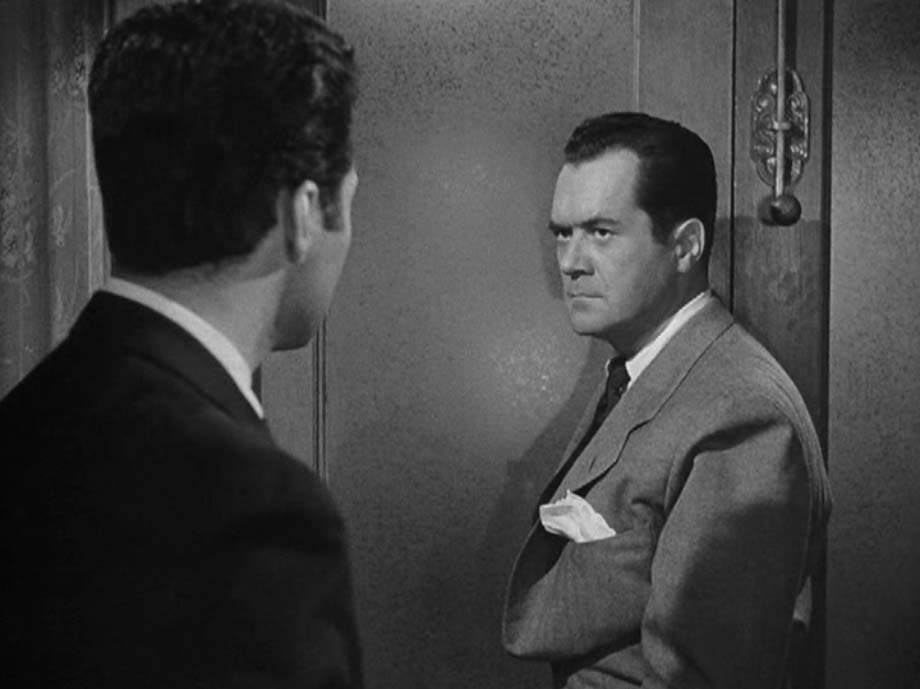
Matt on the receiving end of his brother's hate.
Credits
Director: Gordon Douglas; screenplay: Crane Wilbur; producer: Bryan Foy; music: Max Steiner; cinematography: Edwin DuPar; format: black and white, 83 minutes, 1:37:1 aspect ratio
Cast
Frank Lovejoy (Matt Cvetic); Dorothy Hart (Eve Merrick); Philip Carey (Mason); James Millican (Jim Blandon); Richard Webb: (Ken Crowley); Konstantin Shayne (Gerhardt Eisler); Paul Picerni (Joe Cvetic); Edward Norris (Harmon); Roy Roberts (Father Novak); Ron Hagerthy (Dick Cvetic); Hugh Sanders (Clyde Garson); Hope Kramer (Ruth Cvetic)
Get It Here


